Background
Expedia Group branded customer care support agents (located throughout Philippines, San Salvador, Egypt, North America) face the challenge of having to use different tools and applications (GDS, Classic Voyager, Voyager Flights, Eureka, Brand Site for Agents, etc.) to exchange customer flight bookings. On the Voyager Flights tool, agents have to manually determine penalty, change fee policy, and booking class rules which if done inaccurately lead to airline debit memos that adversely impact the business.
Incomprehensible system errors due to issues in downstream services and the inability to display information due to out of sync booking information when backend systems pull from different data stores also add to the pain points agents experience. When the agents don't know what their next step should be to resolve their customer's problems it leads to dissatisfaction. Tier 2 and Tier 3 agents have to memorize 15+ key commands for the different GDS systems they use to service flight bookings. There existed an opportunity to make a more user friendly interface that could quickly give the agents the information they need and reduce their average handling time.
Design Process
My Role
As the main designer on the project, I worked with the business owner, creative director, product managers, program managers, content strategist, testers, developers, service & delivery, and learning development teams to alleviate the customer pain points and improve the experience faced by the phone agents on complex flight exchange cases. I was a mentor to the designer working on customer self-service flight change. I drafted a design schedule for both our areas and reviewed the other designer's work. I designed around the constraints of an existing visual and interaction style guide and took into consideration the agent's current work flow for how they exchange flights in their current tool. I looked at their mental model for how other products were exchanged in the tool that I'd be building upon. I made design prioritization tradeoffs due to technical and resource limitations and followed design principles around simplicity, focus, clarity and efficiency in the user experience.
Customer Needs
• Improve user experience and increase user confidence. Make it easy and efficient for call center agents to service US and Canadian point of sale flight booking exchanges.
• Improve CSAT (customer satisfaction) for high volume and high effort calls.
• Reduce the customer effort required for 31% of flight exchanges
Business Goals
• Reduce operating costs and optimize the business by increasing the customer's ability to self-service.
• Reduce AHT (average handling time) and agent error costs.
• Reduce call propensity by at least 1% (target: 20%).
Understanding the user: Call Center Agents
When I interviewed and observed call agents at the different customer care centers, I saw they were on the phone with the customer an average of 5 to 15 minutes for simple cases and 30 minutes for complex ones. And, in extreme cases, like those due to weather related schedule changes, an agent could spend 1.5 hours on the phone with the customer and airlines. Customer call time increases for cases that need higher tier level agents/supervisors access and approval.

Call center agents are able to exchange flights for customers.
Call center agents are able to exchange flights for customers.
Design Planning
• Participated in Project Inceptions to gain a shared vision of business priorities, strategy and project scope from Product Management, Line of Business, Development, and additional cross-functional teams. Met with Learning & Development to understand agent workflows and flight exchange and cancel policies and Content Strategists on the Eureka Knowledge Base Tool that agents depend on.
• Drafted and presented design schedule to product management and development/test teams based on dev milestones and the scope of the project.
• Participated in working sessions with PM/DEV/TEST to discuss project scope and technical constraints. Group white boarding sessions to agree on user experience and user flow with shared understanding of data model, and business requirements.
• Created an html design index and Confluence page for the project that displayed the task flow diagrams and links to prototype, mockups deliverables, and redlines/annotations.
Understanding the problem space
Met with my PM/Business owner to gain more background on the flight business and strategy on why the project was important. I learned about the tools the agents use and training they go through.

Research
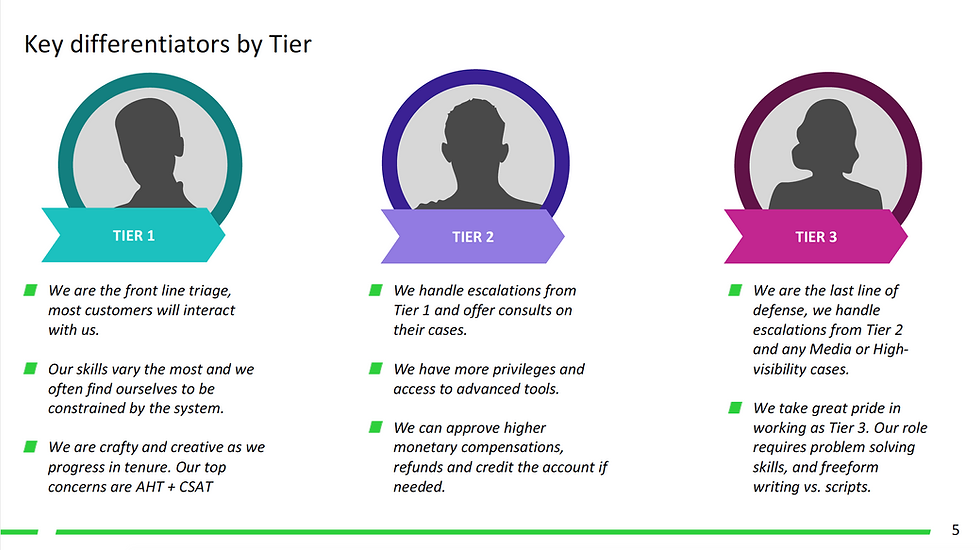
• Observed and interviewed call center agents to understand their workflow and escalation process for the different agent types: Tier 1, Tier 2, and Tier 3 (Complex Air Agents).
• Consulted with subject matter expert from the service delivery team and the line of business product managers on knowledge collected from past survey results and call center agent visits. The goal was to understand the issues that had the biggest impact on the business and the user experience pain points.
• Competitive analysis and heuristic evaluation of airline websites (United, Alaska, etc.).
• Task analysis and evaluation of the current user experience (Voyager Flights tool) that was being used to exchange, cancel, and void flights by Tier 1 agents in US/CANADA.
• Researched how the GDS is being used by Tier 2 agents and Complex Air agents.
User Scenarios
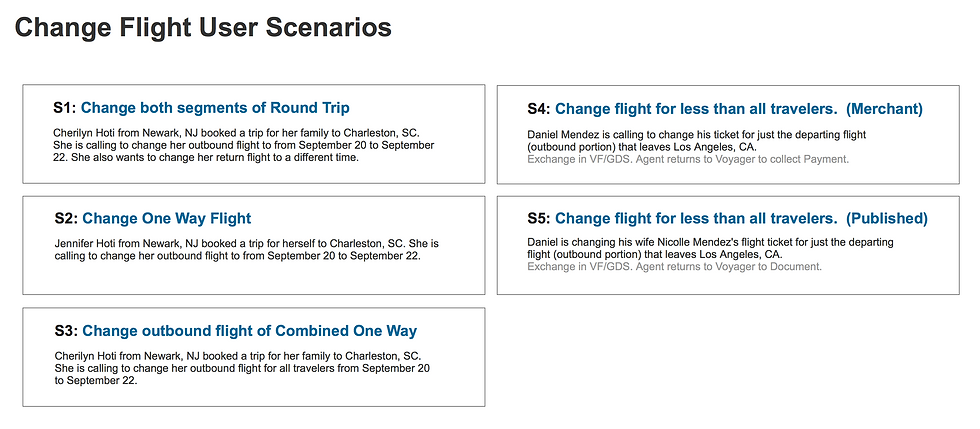
Identified key scenarios and use cases. Created wireframe screens in Sketch. Built out multiple prototypes in Axure for usability testing.
User Task Flow Diagram
I delivered scenario flows for the different use cases and handed off design for the following screen deliverables: Select Flights/Travelers, Search, Search Results, Review, Confirmation, and confirmation email template. I contributed to the style guide by introducing a new layout pattern on the Review screen for displaying the amount due for a flight exchange.
For the customer self-service portion, I delivered on the review, checkout, and confirmation user experience and ensured the end to end self-service flow worked for responsive web.

Design Deliverables
Created an html index page for the designs. Planned for a design schedule that took into consideration the multiple design iterations with usability testing as well as feedback from reviews with business owners.


Drafted a schedule and worked with dev team on alignment of the design deliverable dates would work with the dev milestones.
Drafted a schedule and worked with dev team on alignment of the design deliverable dates would work with the dev milestones.
Focus Group Session
Agents prioritized most common used tasks they use in Voyager Flights.


Background
Expedia Group branded customer care support agents (located throughout Philippines, San Salvador, Egypt, North America) face the challenge of having to use different tools and applications (GDS, Classic Voyager, Voyager Flights, Eureka, Brand Site for Agents, etc.) to exchange customer flight bookings. On the Voyager Flights tool, agents have to manually determine penalty, change fee policy, and booking class rules which if done inaccurately lead to airline debit memos that adversely impact the business.
Incomprehensible system errors due to issues in downstream services and the inability to display information due to out of sync booking information when backend systems pull from different data stores also add to the pain points agents experience. When the agents don't know what their next step should be to resolve their customer's problems it leads to dissatisfaction. Tier 2 and Tier 3 agents have to memorize 15+ key commands for the different GDS systems they use to service flight bookings. There existed an opportunity to make a more user friendly interface that could quickly give the agents the information they need and reduce their average handling time.
Design Process

AI Design Practice
Designing how humans and AI work together and being intentional about what the system handles and what the person retains is important to me. Responsible AI requires clarity and interpretability that is equitable and free from bias.
AI PROJECTS. Building with AI, not just designing for it.
HireMe BlueJay Coach — Agentic AI Interview Coaching System
Johns Hopkins Carey Business School, Generative AI (BU.330.760), Spring 2025
Python · LangChain · GPT-4 Turbo · FAISS · MLP · Responsible AI
A RAG-based agentic AI coaching system that ingests candidate documents, job descriptions, and coaching guides across three FAISS vector stores, then orchestrates a multi-tool planning agent to generate STAR interview questions, response coaching with verbal and non-verbal guidance, and professional growth recommendations.
Key capabilities built:
-
Hierarchical Planning — separates high-level coaching goals from execution steps using LangChain's PlanAndExecute agent
-
Chain-of-Thought Reasoning — step-by-step reasoning instructions across all prompts for transparent, logical outputs
-
MLP Fine-Tuning — trainable Multi-Layer Perceptron classifier for response quality assessment, trained for 10 epochs; enables automatic regeneration of low-quality outputs
-
Uncertainty Estimation — confidence scoring (0–1 scale) with flagging for human review, supporting responsible deployment
-
Theory of Mind Modeling — simulates technical, executive, and skeptical interviewer perspectives for cross-functional coaching
-
Responsible AI guardrails — bias sanitization, fairness trigger logging, ethical framing; system never simulates hiring decisions
Built as a capstone applying course concepts in agentic reasoning, RAG, fairness, and responsible AI governance to a real-world human-centered coaching domain.
Grand Slam Tennis — Interactive Browser Game
Johns Hopkins Carey Business School, Human AI Fusion (BU.330.765), Spring 2026
Vanilla JavaScript · HTML Canvas · Claude (vibe coding)
A fully playable browser-based Grand Slam tennis game built entirely through vibe coding — prototyping directly in HTML and JavaScript in collaboration with Claude. Four Grand Slam courts (Australian Open, French Open, Wimbledon, US Open) with distinct surface physics, three shot types (flat, slice, topspin), serve speed gun in MPH, weather conditions affecting ball speed and visibility, full tennis scoring with deuce and advantage, stats tracking, leaderboard, and multiple music tracks.
Built to demonstrate that vibe coding produces complete, polished interactive experiences — not just wireframes or static mockups. This is the AI-assisted design workflow I created in 2 nights, made tangible and playable.
Market Research — Comparative Prompt Engineering Study
Johns Hopkins Carey Business School, Generative AI (BU.330.760), Spring 2025
GPT-4. Claude 3. Persona Development Chain-of-thought. Hallucination detection
Comparative prompt engineering research evaluating GPT-4 vs. Claude 3 across expert personas (economist, AI researcher, venture capitalist, McKinsey consultant, AI futurist). Identified and documented two fabricated statistics; cross-referenced and removed.
Key insight: LLM outputs require human judgment at the synthesis layer — a design principle that directly informs my thinking about trust and oversight.

Space Junk & Orbital Debris — Predictive Collision Risk Model
Johns Hopkins Carey Business School, Big Data and Machine Learning (BU.520.710), Spring 2024
Python · Scikit-Learn · XGBoost · RandomForest · SMOTE · GridSearchCV · K-Fold Cross-Validation
A collaborative machine learning project predicting orbital debris collision risk using the European Space Agency's Kelvins dataset (24,484 rows, 103 columns of satellite position, velocity, and covariance data). Built two distinct models for two distinct questions: will a collision happen (binary classification) and what is the likelihood of collision on a continuous risk scale (regression).
My contributions:
scaling problematic covariance columns, eliminating inappropriate features, instantiating both models, hyperparameter tuning, and performance evaluation (Modules 7 & 8). Partner contribution: dataset cleaning, EDA, and feature analysis.
Technical approach:
-
Built two models matching two problem types: RandomForestClassifier (binary: collision yes/no) and RandomForestRegressor + XGBoost VotingRegressor (continuous: high vs. low risk likelihood)
-
Applied SMOTE for class imbalance, GridSearchCV with Pipeline and StandardScaler for hyperparameter optimization, K-fold cross-validation (5 splits) for overfitting prevention
-
Deliberately excluded columns derived from undisclosed algorithmic calculations (max_risk_estimate, max_risk_scaling, recommended span columns) — choosing not to rely on black-box inputs in a safety-critical model
-
Final model performance: RandomForestClassifier ROC AUC 0.97, Accuracy 0.97, F1 0.97; VotingRegressor R-squared 0.8756
Why it matters for design:
Designing interfaces that surface model confidence, explain collision risk predictions, and support human decision-making on whether to execute avoidance maneuvers requires understanding how the underlying ML model works — what it outputs, where it is uncertain, and what the failure modes look like. The decision to exclude black-box derived inputs is the same responsible AI principle that guides how I design human oversight into AI-powered experiences.
Watch video presentation walkthrough →


SELECTED DESIGN WORK


Blue Origin — Test & Flight Operations Mission Management
(NDA-protected; generalized artifacts available on portfolio) User research on AI agent interactions and vibe-coded prototypes for operational workflow experiences in high-stakes environments. Structured user research evaluating LLM conversational approaches, interaction pattern recommendations for human oversight and trust design.
Space Mission Outcomes — Tableau Data Visualization
Multi-chapter Tableau data story exploring orbital mission outcomes across agencies, vehicle types, and time. Johns Hopkins MBA coursework demonstrating data exploration and narrative design as a design practice.
View Project → | Watch video presentation walkthrough →
Expedia — Virtual Agent Chatbot Platform & Payments Widget
Interaction model design for a tier 1 automated airline customer support experience, with Payments Widget embedded in the conversational flow. Defined the escalation model routing complex cases from AI automation to human agents.
Expedia — Travel Connect
Zero-to-one enterprise platform design with no established precedent — resulted in two new organizations including a developer tools platform and a payments platform. Led design from discovery through delivery across a global cross-functional team.
The Work
For the past year at Blue Origin, I have been conducting user research on AI agent interactions and prototyping AI-first experience concepts for operational workflows — work that sits at the intersection of human-centered design research and emerging AI product development.
My research and design focus has centered on three interconnected questions:
How do users build trust in AI Systems?
Through structured user research evaluating LLM conversational approaches, I study how technically sophisticated users interpret AI outputs, where they apply judgment versus defer to the system, and what interaction patterns build — or erode — confidence.
Where should humans stay in the loop?
I identify the intervention points, escalation moments, and review workflows where human judgment must remain central — and translate those findings into interaction pattern recommendations.
How do you prototype non-deterministic experiences?
I use vibe coding — prototyping in HTML using Claude — to build functional, testable interaction concepts that simulate AI-driven interfaces before engineering commits to a direction.
AI-NATIVE DESIGN WORKFLOW
I prototype directly in HTML using Claude, building functional interactive experiences that reach approximately 80% of production quality before applying focused design judgment to achieve the final 20%. This practice — sometimes called vibe coding — accelerates validation, reduces the gap between design intent and implementation, and keeps me genuinely close to the technical systems I'm designing for.
I use Figma Make to extend prototypes into higher-fidelity explorations, and Figma Dev Mode to tighten the handoff with engineering. The result is a design process that moves at the speed of an AI-enabled team.
RESPONSIBLE AI
Safety and ethics are not constraints I design around — they are the lens I design through.
My approach to responsible AI is grounded in MBA coursework at Johns Hopkins Carey Business School, including a case study on Philips Healthcare AI platform governance examining ethics, bias mitigation, and regulatory compliance in clinical AI systems. My global immersions across London, India, Chile, Frankfurt, and Milan shaped how I think about the diverse ways different people relate to AI systems, consent, and trust — and how cultural differences need to inform design decisions, not just policy documents.
I bring a business and governance literacy to AI design understanding how regulatory frameworks (EMA, GDPR, MDR vs. FDA, HIPAA) create real product constraints, and how responsible AI principles translate from coursework into interaction decisions.
INTERESTS
-
How engineers and AI agents will collaborate on software — instrumentation, experimentation, and evaluation
-
How AI systems communicate uncertainty in ways that earn rather than assume trust
-
How responsible AI governance gets designed into products from the first interaction, not retrofitted after launch
-
How vibe coding changes the relationship between design and engineering — and what that means for how teams build together