Background
Expedia Group branded customer care support agents (located throughout Philippines, San Salvador, Egypt, North America) face the challenge of having to use different tools and applications (GDS, Classic Voyager, Voyager Flights, Eureka, Brand Site for Agents, etc.) to exchange customer flight bookings. On the Voyager Flights tool, agents have to manually determine penalty, change fee policy, and booking class rules which if done inaccurately lead to airline debit memos that adversely impact the business.
Incomprehensible system errors due to issues in downstream services and the inability to display information due to out of sync booking information when backend systems pull from different data stores also add to the pain points agents experience. When the agents don't know what their next step should be to resolve their customer's problems it leads to dissatisfaction. Tier 2 and Tier 3 agents have to memorize 15+ key commands for the different GDS systems they use to service flight bookings. There existed an opportunity to make a more user friendly interface that could quickly give the agents the information they need and reduce their average handling time.
Design Process
My Role
As the main designer on the project, I worked with the business owner, creative director, product managers, program managers, content strategist, testers, developers, service & delivery, and learning development teams to alleviate the customer pain points and improve the experience faced by the phone agents on complex flight exchange cases. I was a mentor to the designer working on customer self-service flight change. I drafted a design schedule for both our areas and reviewed the other designer's work. I designed around the constraints of an existing visual and interaction style guide and took into consideration the agent's current work flow for how they exchange flights in their current tool. I looked at their mental model for how other products were exchanged in the tool that I'd be building upon. I made design prioritization tradeoffs due to technical and resource limitations and followed design principles around simplicity, focus, clarity and efficiency in the user experience.
Customer Needs
• Improve user experience and increase user confidence. Make it easy and efficient for call center agents to service US and Canadian point of sale flight booking exchanges.
• Improve CSAT (customer satisfaction) for high volume and high effort calls.
• Reduce the customer effort required for 31% of flight exchanges
Business Goals
• Reduce operating costs and optimize the business by increasing the customer's ability to self-service.
• Reduce AHT (average handling time) and agent error costs.
• Reduce call propensity by at least 1% (target: 20%).
Understanding the user: Call Center Agents
When I interviewed and observed call agents at the different customer care centers, I saw they were on the phone with the customer an average of 5 to 15 minutes for simple cases and 30 minutes for complex ones. And, in extreme cases, like those due to weather related schedule changes, an agent could spend 1.5 hours on the phone with the customer and airlines. Customer call time increases for cases that need higher tier level agents/supervisors access and approval.

Call center agents are able to exchange flights for customers.
Call center agents are able to exchange flights for customers.
Design Planning
• Participated in Project Inceptions to gain a shared vision of business priorities, strategy and project scope from Product Management, Line of Business, Development, and additional cross-functional teams. Met with Learning & Development to understand agent workflows and flight exchange and cancel policies and Content Strategists on the Eureka Knowledge Base Tool that agents depend on.
• Drafted and presented design schedule to product management and development/test teams based on dev milestones and the scope of the project.
• Participated in working sessions with PM/DEV/TEST to discuss project scope and technical constraints. Group white boarding sessions to agree on user experience and user flow with shared understanding of data model, and business requirements.
• Created an html design index and Confluence page for the project that displayed the task flow diagrams and links to prototype, mockups deliverables, and redlines/annotations.
Understanding the problem space
Met with my PM/Business owner to gain more background on the flight business and strategy on why the project was important. I learned about the tools the agents use and training they go through.

Research
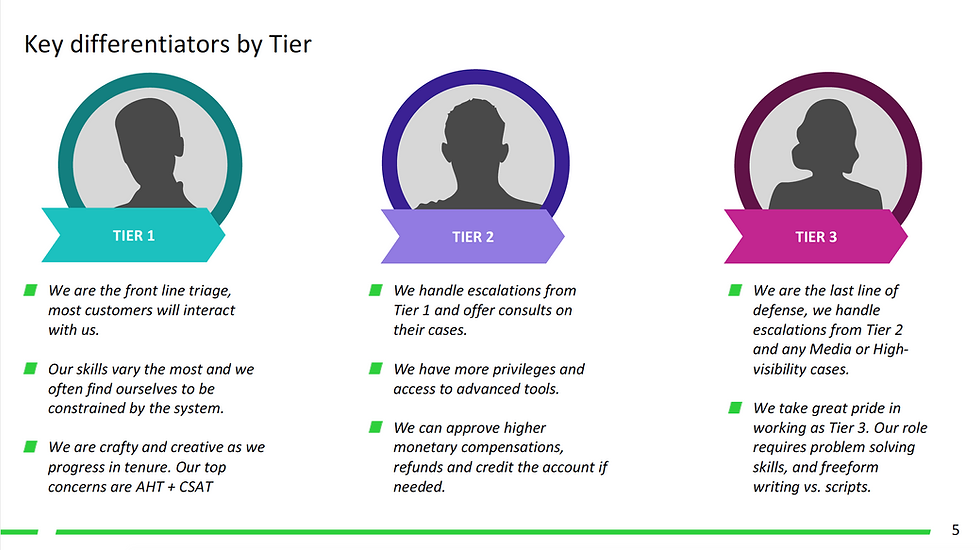
• Observed and interviewed call center agents to understand their workflow and escalation process for the different agent types: Tier 1, Tier 2, and Tier 3 (Complex Air Agents).
• Consulted with subject matter expert from the service delivery team and the line of business product managers on knowledge collected from past survey results and call center agent visits. The goal was to understand the issues that had the biggest impact on the business and the user experience pain points.
• Competitive analysis and heuristic evaluation of airline websites (United, Alaska, etc.).
• Task analysis and evaluation of the current user experience (Voyager Flights tool) that was being used to exchange, cancel, and void flights by Tier 1 agents in US/CANADA.
• Researched how the GDS is being used by Tier 2 agents and Complex Air agents.
User Scenarios
Identified key scenarios and use cases. Created wireframe screens in Sketch. Built out multiple prototypes in Axure for usability testing.
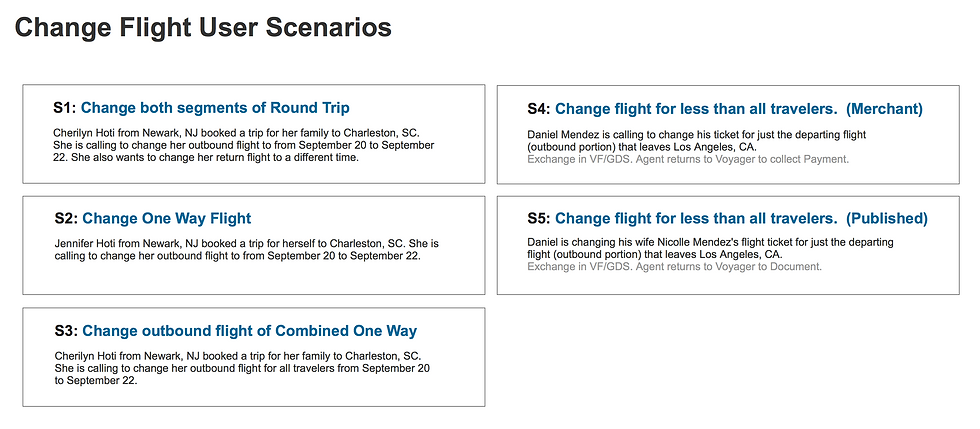
User Task Flow Diagram
I delivered scenario flows for the different use cases and handed off design for the following screen deliverables: Select Flights/Travelers, Search, Search Results, Review, Confirmation, and confirmation email template. I contributed to the style guide by introducing a new layout pattern on the Review screen for displaying the amount due for a flight exchange.
For the customer self-service portion, I delivered on the review, checkout, and confirmation user experience and ensured the end to end self-service flow worked for responsive web.

Design Deliverables
Created an html index page for the designs. Planned for a design schedule that took into consideration the multiple design iterations with usability testing as well as feedback from reviews with business owners.


Drafted a schedule and worked with dev team on alignment of the design deliverable dates would work with the dev milestones.
Drafted a schedule and worked with dev team on alignment of the design deliverable dates would work with the dev milestones.
Focus Group Session
Agents prioritized most common used tasks they use in Voyager Flights.


Background
Expedia Group branded customer care support agents (located throughout Philippines, San Salvador, Egypt, North America) face the challenge of having to use different tools and applications (GDS, Classic Voyager, Voyager Flights, Eureka, Brand Site for Agents, etc.) to exchange customer flight bookings. On the Voyager Flights tool, agents have to manually determine penalty, change fee policy, and booking class rules which if done inaccurately lead to airline debit memos that adversely impact the business.
Incomprehensible system errors due to issues in downstream services and the inability to display information due to out of sync booking information when backend systems pull from different data stores also add to the pain points agents experience. When the agents don't know what their next step should be to resolve their customer's problems it leads to dissatisfaction. Tier 2 and Tier 3 agents have to memorize 15+ key commands for the different GDS systems they use to service flight bookings. There existed an opportunity to make a more user friendly interface that could quickly give the agents the information they need and reduce their average handling time.
Design Process

Blue Origin
Test & Flight Operations
As a Senior UX Designer within Blue Origin’s Enterprise Technologies,
I specialize in optimizing complex aerospace data into effective, intuitive interfaces.
-
Innovation: Researched and evaluated LLM integration approaches for technical workflows.
-
Impact: Led discovery work that secured project funding and earned the Lift-Off Award.
-
Vision: Strategic research featured at ISSRDC 2024 and integrated into NASA collaboration.
-
Scale: Contributed to the enterprise design system.
To respect NDAs, all visuals are sanitized or recreated to focus on strategy, logic, and impact.

Mission Management & Strategic Vision
Bridging Engineering Workflows and Business Expansion
The Challenge
When I joined the team, the mission management and payload telemetry landscape was technically dense and differentiated across four distinct business units. Through this discovery work, we uncovered user needs, challenges, and opportunities to leverage learnings across our different business segments.
The Strategy: Multi-Divisional Discovery
To synthesize a "North Star" vision, I led a ux design and research initiative on Payload Mission Management:
-
Cross-Functional Interviews: Engaged a diverse cohort—including Mission Management, Systems Engineers, Integrators, and Operators.
-
Journey Mapping: Facilitated collaborative sessions with mission managers, engineers, and payload managers to map the end-to-end payload lifecycle, identifying critical friction points in the process, and voice of the customer.
-
Roadmap Prioritization: Translated insights into intake planning, user needs, and business requirements.
The Design Philosophy
-
Customer-Centricity: Reframed and focused on "what we build" to "how the customer experiences the mission,"
-
Unified Narrative: Developed a consistent visual and functional language that allowed stakeholders across four business units to see their work as part of a single, cohesive ecosystem.
-
Scalable Frameworks: Designed the journey maps and research artifacts to serve as a repeatable blueprint for future service models.
The Impact
The research resulted in a design framework integrated into a high-profile industry proposal and featured at ISSRDC 2024 by Orbital Reef's Chief Scientist at a major industry conference to demonstrate the vision for future space habitat services.
View Conference Public Technical Session (Slide 7)

External Partner Data Portal & Orbital Access
From Conceptual Pivot to Cross-Functional Adoption
The Challenge
The vision was for a research scientist to open their mobile app on a Sunday morning and check the health status of their science experiment from home. We wanted to enable external researchers and partners to monitor on-orbit experiments in real time, without requiring a physical presence in mission control or compromising security.
The Strategy: Strategic Resilience
Midway through discovery, the project's scope and priorities shifted. Rather than letting the work stall, I took an "intrapreneurial" approach to keep it moving:
-
Reframing the Value Proposition: Synthesized the existing research and technical thinking into a clear, high-level case for why this capability mattered beyond its original scope.
-
Stakeholder Alignment: Led concept work and presentations across teams to show how a secure external portal could solve real customer bottlenecks.
-
Concept Refinement: Facilitated discovery sprints to ensure the proposed solution met the rigorous security and data-handling requirements of a multi-tenant platform.
The Design Philosophy
-
Accessibility for Non-Experts: Focused on reducing the cognitive barrier to entry, designing an intuitive interface that made complex telemetry streams understandable for external researchers.
-
Modular Architecture: Designed the portal as a templated solution, so different teams could plug their own data streams into a unified UI.
-
Secure Collaboration: Prioritized a self-service model for requests, letting partners interact with mission assets through a secure, gated workflow.
The Impact
The concept work became a reference point for how the organization could approach external partner access going forward, and my design established the foundational visual and functional template for future work in this space — a North Star for how the company could let external partners engage with mission assets securely.

Next-Gen Procedural Tooling
Optimizing Reliability and Safety in Aerospace Operations
The Challenge
In aerospace testing and launch operations, procedures are the "scripts" for success. The existing legacy tools were often fragmented, leading to high cognitive load for engineers during time-sensitive "hotfire" tests and launch preparations. My goal was to design a next-generation procedural tool that could handle extreme complexity while maintaining absolute clarity and safety.
The Strategy: Immersive Discovery
To understand the high-pressure environment of a test stand or a console, I went beyond the desk:
-
Direct Observation: Conducted multiple site visits to witness live test operations, observing how engineers interacted with software under real-world stress.
-
Co-Creation Workshops: Led collaborative sessions with Test Engineers and Launch Operators to prioritize features that would actually reduce error rates in the field.
-
Rapid Prototyping: Developed interactive prototypes to simulate high-velocity data environments, ensuring that critical alerts and procedural steps remained the primary focus.
The Design Philosophy
-
Complexity without Clutter: I focused on "progressive disclosure," optimizing the experience for engineers by showing exactly what they needed for the current step while keeping the broader mission context accessible.
-
Feedback Loops: Integrated real-time validation into the UI so that operators received immediate confirmation of successful command execution.
-
System Thinking: Collaborated with development engineers to ensure the MVP was technically viable for the unique constraints of live telemetry and legacy hardware, solving for the most critical user needs.
The Impact
The MVP project was successfully tested with internal customers and added to in mission-critical preparations. It garnered the support of business owners and director leadership. The project team received a "Lift-Off Award" for innovation, recognizing the future procedural tool's significant impact on improving operational readiness and safety in the field.
High-Volume Telemetry Analysis
Streamlining Data Synthesis for Test/Flight Reviews
The Challenge
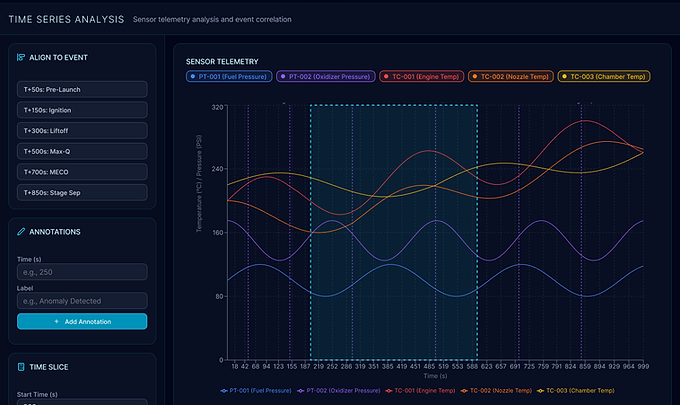
Following a test or flight event, engineers faced a significant bottleneck: the "Time-to-Insight." Research revealed that engineers were spending disproportionate time manually configuring complex plots and traces before they could even begin analyzing data. The goal was to transform a repetitive, manual setup process into a streamlined, high-performance interface for post-hotfire and launch reviews.
The Strategy: Targeted Discovery
To move beyond a generic dashboard, I led a targeted discovery phase focused on engineering efficiency:
-
Feature Prioritization: Conducted surveys and interviews to identify which manual tasks were the primary drivers of "analysis fatigue," discovering that plot setup was the single largest time-sink.
-
User Interviews: Engaged directly with engineers to identify the specific friction points where manual workarounds were slowing down the analysis pipeline
-
Iterative Prototyping: Developed interactive prototype to ensure user interface was intuitive. Worked closely with development engineers and customers to optimize the experience.
The Design Philosophy
-
Reducing Setup Friction: Redesigned the interface canvas to support Custom Saved Plot, allowing engineers to create, save, and instantly recall complex configuration templates for recurring test cycles.
-
Functional Expansion: Evolved the platform from a simple viewer into a comprehensive one, building out those specific features that supported time savings when conducting "quick-looks" and deep "ad-hoc" analysis.
-
Cross-Team Synergy: Partnered across product teams and development teams to design a shared UX/UI component, ensuring that analysis patterns would work in the broader ecosystem.
The Impact
The implementation of saved plot configurations is projected to shift the engineering workflow, to reduce setup time, and allow teams to focus on hardware qualification rather than tool configuration, with the goal of accelerating the speed of engineering decisions across the organization.