Background
Expedia Group branded customer care support agents (located throughout Philippines, San Salvador, Egypt, North America) face the challenge of having to use different tools and applications (GDS, Classic Voyager, Voyager Flights, Eureka, Brand Site for Agents, etc.) to exchange customer flight bookings. On the Voyager Flights tool, agents have to manually determine penalty, change fee policy, and booking class rules which if done inaccurately lead to airline debit memos that adversely impact the business.
Incomprehensible system errors due to issues in downstream services and the inability to display information due to out of sync booking information when backend systems pull from different data stores also add to the pain points agents experience. When the agents don't know what their next step should be to resolve their customer's problems it leads to dissatisfaction. Tier 2 and Tier 3 agents have to memorize 15+ key commands for the different GDS systems they use to service flight bookings. There existed an opportunity to make a more user friendly interface that could quickly give the agents the information they need and reduce their average handling time.
Design Process
My Role
As the main designer on the project, I worked with the business owner, creative director, product managers, program managers, content strategist, testers, developers, service & delivery, and learning development teams to alleviate the customer pain points and improve the experience faced by the phone agents on complex flight exchange cases. I was a mentor to the designer working on customer self-service flight change. I drafted a design schedule for both our areas and reviewed the other designer's work. I designed around the constraints of an existing visual and interaction style guide and took into consideration the agent's current work flow for how they exchange flights in their current tool. I looked at their mental model for how other products were exchanged in the tool that I'd be building upon. I made design prioritization tradeoffs due to technical and resource limitations and followed design principles around simplicity, focus, clarity and efficiency in the user experience.
Customer Needs
• Improve user experience and increase user confidence. Make it easy and efficient for call center agents to service US and Canadian point of sale flight booking exchanges.
• Improve CSAT (customer satisfaction) for high volume and high effort calls.
• Reduce the customer effort required for 31% of flight exchanges
Business Goals
• Reduce operating costs and optimize the business by increasing the customer's ability to self-service.
• Reduce AHT (average handling time) and agent error costs.
• Reduce call propensity by at least 1% (target: 20%).
Understanding the user: Call Center Agents
When I interviewed and observed call agents at the different customer care centers, I saw they were on the phone with the customer an average of 5 to 15 minutes for simple cases and 30 minutes for complex ones. And, in extreme cases, like those due to weather related schedule changes, an agent could spend 1.5 hours on the phone with the customer and airlines. Customer call time increases for cases that need higher tier level agents/supervisors access and approval.

Call center agents are able to exchange flights for customers.
Call center agents are able to exchange flights for customers.
Design Planning
• Participated in Project Inceptions to gain a shared vision of business priorities, strategy and project scope from Product Management, Line of Business, Development, and additional cross-functional teams. Met with Learning & Development to understand agent workflows and flight exchange and cancel policies and Content Strategists on the Eureka Knowledge Base Tool that agents depend on.
• Drafted and presented design schedule to product management and development/test teams based on dev milestones and the scope of the project.
• Participated in working sessions with PM/DEV/TEST to discuss project scope and technical constraints. Group white boarding sessions to agree on user experience and user flow with shared understanding of data model, and business requirements.
• Created an html design index and Confluence page for the project that displayed the task flow diagrams and links to prototype, mockups deliverables, and redlines/annotations.
Understanding the problem space
Met with my PM/Business owner to gain more background on the flight business and strategy on why the project was important. I learned about the tools the agents use and training they go through.

Research
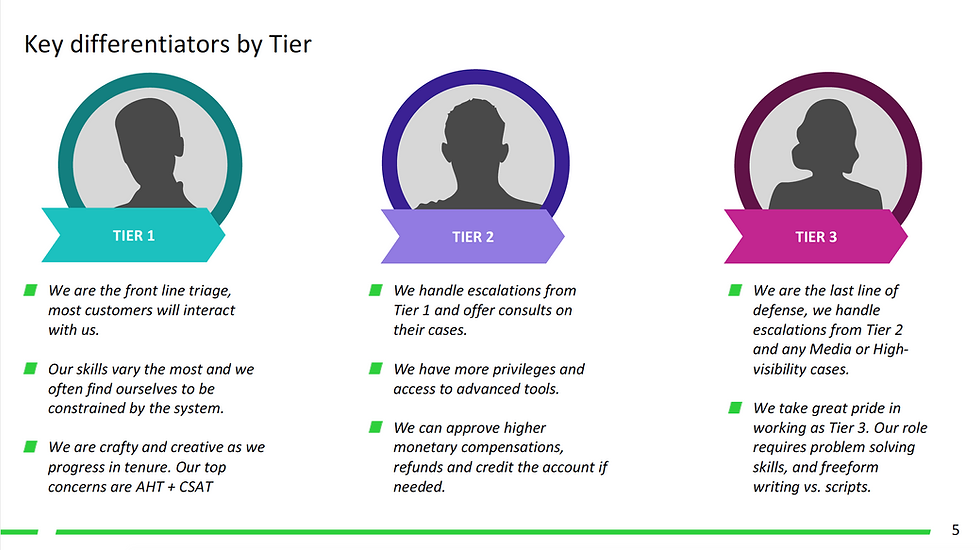
• Observed and interviewed call center agents to understand their workflow and escalation process for the different agent types: Tier 1, Tier 2, and Tier 3 (Complex Air Agents).
• Consulted with subject matter expert from the service delivery team and the line of business product managers on knowledge collected from past survey results and call center agent visits. The goal was to understand the issues that had the biggest impact on the business and the user experience pain points.
• Competitive analysis and heuristic evaluation of airline websites (United, Alaska, etc.).
• Task analysis and evaluation of the current user experience (Voyager Flights tool) that was being used to exchange, cancel, and void flights by Tier 1 agents in US/CANADA.
• Researched how the GDS is being used by Tier 2 agents and Complex Air agents.
User Scenarios
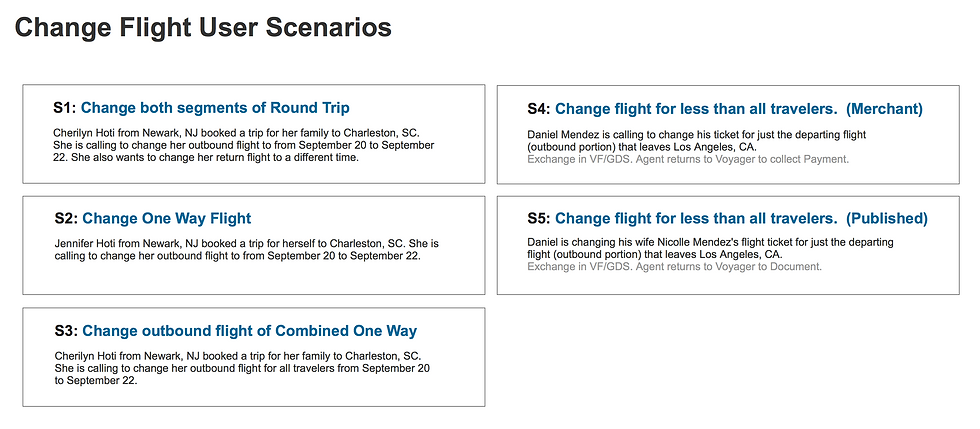
Identified key scenarios and use cases. Created wireframe screens in Sketch. Built out multiple prototypes in Axure for usability testing.
User Task Flow Diagram
I delivered scenario flows for the different use cases and handed off design for the following screen deliverables: Select Flights/Travelers, Search, Search Results, Review, Confirmation, and confirmation email template. I contributed to the style guide by introducing a new layout pattern on the Review screen for displaying the amount due for a flight exchange.
For the customer self-service portion, I delivered on the review, checkout, and confirmation user experience and ensured the end to end self-service flow worked for responsive web.

Design Deliverables
Created an html index page for the designs. Planned for a design schedule that took into consideration the multiple design iterations with usability testing as well as feedback from reviews with business owners.


Drafted a schedule and worked with dev team on alignment of the design deliverable dates would work with the dev milestones.
Drafted a schedule and worked with dev team on alignment of the design deliverable dates would work with the dev milestones.
Focus Group Session
Agents prioritized most common used tasks they use in Voyager Flights.


Background
Expedia Group branded customer care support agents (located throughout Philippines, San Salvador, Egypt, North America) face the challenge of having to use different tools and applications (GDS, Classic Voyager, Voyager Flights, Eureka, Brand Site for Agents, etc.) to exchange customer flight bookings. On the Voyager Flights tool, agents have to manually determine penalty, change fee policy, and booking class rules which if done inaccurately lead to airline debit memos that adversely impact the business.
Incomprehensible system errors due to issues in downstream services and the inability to display information due to out of sync booking information when backend systems pull from different data stores also add to the pain points agents experience. When the agents don't know what their next step should be to resolve their customer's problems it leads to dissatisfaction. Tier 2 and Tier 3 agents have to memorize 15+ key commands for the different GDS systems they use to service flight bookings. There existed an opportunity to make a more user friendly interface that could quickly give the agents the information they need and reduce their average handling time.
Design Process
Smartsheet
Data Flows
Designed experiences for companies to upload and offload data from cloud storage and between files within Smartsheet.

Overview
From March 2021 through Dec 2021, I was Design Manager for both the Enterprise Admin and the Data Flows Pillar.
The Data Flows pillar involved the product areas of Jira Connectors, Data Shuttle, Data Mesh, and Bridge Automations.
The Data Flows Engineering Development Team and Product Management were located in Edinburgh Scotland. I would oversee one designer there and then grew the team from one designer to three designers.
I assessed the design work in the space making note of key project initiatives, upcoming dates, and deliverables. I focused on building trust with the teams despite the time and location differences. I learned fast to create partnerships and domain knowledge in the space. I established weekly product-ux-dev sync meetings and had an extra meeting at the end of the week for office hours on Fridays were I could field any design questions in our video call meetings. Used company slack channel to field questions async to prep and obtain background for those meetings.
For projects and processes, I partnered with the new researcher in London, existing product manager who was also staffing up his PM team, and two dev engineering teams to align on near term vision and future projects in the space. I focused on staffing up the team in anticipation to prepare for a northstar future vision of the Data Hub initiative once we had the working team across design/pm/engineering properly staffed up.
Updated design for Data Shuttle:
The user experience is now full-screen with ability to upload your data source to either a target sheet or Data Table.
Design projects I led in partnership with my Project Manager and Engineering Manager:
— Accessible user interface for keyboard shortcuts and aria tags for Data Shuttle and Jira Connectors. Delivered accessibility specs working in partnership with content designer, reviewed builds, and connected teams for expectations and reviews with central accessibility team.
— Data Table within Data Shuttle. Scope of the project increased after the initial hand-off of designs in April. Connected with designer on Data Table and led workshop session with stakeholders to get alignment between the product and dev teams in Edinburgh, Scotland and Boston, MA. Result was alignment on design direction that was both viable and feasible per the short timeline.
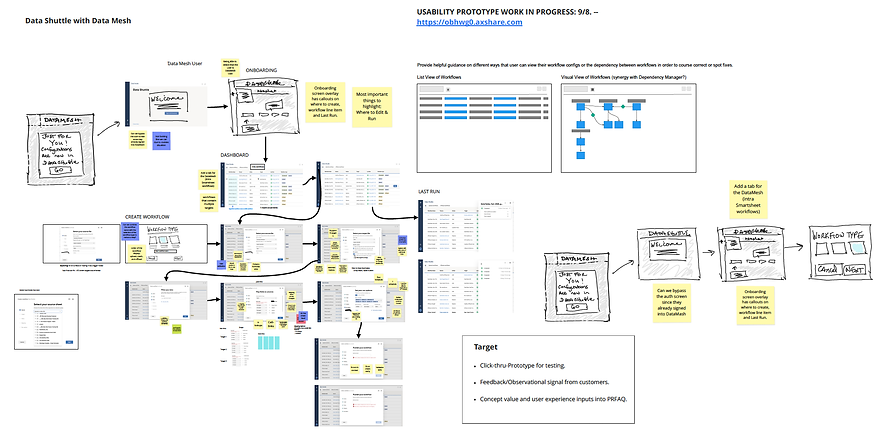
— Data Shuttle for across sheet data transfers. Deliver vision on integrating the legacy Data Mesh product into the new user experience of Data Shuttle. Led design sprint workshop to align on design principles and vision that leveraged business viability and dev feasibility and customer research. Facilitated the workshops were as a triad with dev, pm, and ux we explored the user problem space and opportunities. The result was I created a prototype that my researcher tested and obtained customer feedback on. The results of the sprint fed into Customer Problem Definition Doc that was presented to leadership review to out on the product roadmap.
Design updates I made:
— I created a work tracker for the deliverables and reviewed work and conducted 1:1’s for career growth of the designer who was working on Bridge Automated Workflows.
— Future vision for Data Mesh
— Improved Design: Streamlined to Jira Connector Flow to have inline surface updating of information instead of multiple modal to save time and reduce friction.
— Improved Design: Full-screen experience for Data Shuttle.
— Improved mapping with column properties user interface improvement in Data Shuttle.
— Improved error messaging and detection for faster and clearer awareness in Data Shuttle.
Prototypes:

Attention to Details:
-
Workflow Run Log: Make sure feedback is easily accessible, clear, specific, and actionable
Design Partnership with Engineering Team/Developers and Project Management:
-
Reviewing Build Environment: Updates from Design System Styleguide to dev tokens used in separate Storybook Environments. Working through process cross-functional team can make timely updates for items in working dev-agile sprints.

Design Working Sessions
When kicking off an ambiguous project. As a working team of design, research, pm, and engineering, we engage in understanding the user (both existing and potential customers), align and define the problem we want to solve. We'll put together our schedule and engage in a series of design activities and working sessions to innovate and progress for what we want to build out.
-
Customer Discovery Sessions
Partnership with User Researcher to empathize with the customers and discover pain points and user needs walking through the jobs they do engaging with the product. 6+ customers were involved in these discovery sessions.

-
Design Principles
Evangelize with Product Management and Engineering Team. Discuss how Design Principles relate to specific experiences in the product.

-
Dev-Feasability Check
Engaged in discussions with engineering team to talk about scope and consideration points. Brainstorm ways to improve the user experience and user interface.

-
Heuristic Evaluation
Reviewing the current experience. What is working and not working. What will need to change for the best experience.
-
Customer Journey
With the working team, identifying the actions and touchpoints that the user has at different stages of the experience and where the opportunities exist.
