Background
Expedia Group branded customer care support agents (located throughout Philippines, San Salvador, Egypt, North America) face the challenge of having to use different tools and applications (GDS, Classic Voyager, Voyager Flights, Eureka, Brand Site for Agents, etc.) to exchange customer flight bookings. On the Voyager Flights tool, agents have to manually determine penalty, change fee policy, and booking class rules which if done inaccurately lead to airline debit memos that adversely impact the business.
Incomprehensible system errors due to issues in downstream services and the inability to display information due to out of sync booking information when backend systems pull from different data stores also add to the pain points agents experience. When the agents don't know what their next step should be to resolve their customer's problems it leads to dissatisfaction. Tier 2 and Tier 3 agents have to memorize 15+ key commands for the different GDS systems they use to service flight bookings. There existed an opportunity to make a more user friendly interface that could quickly give the agents the information they need and reduce their average handling time.
Design Process
My Role
As the main designer on the project, I worked with the business owner, creative director, product managers, program managers, content strategist, testers, developers, service & delivery, and learning development teams to alleviate the customer pain points and improve the experience faced by the phone agents on complex flight exchange cases. I was a mentor to the designer working on customer self-service flight change. I drafted a design schedule for both our areas and reviewed the other designer's work. I designed around the constraints of an existing visual and interaction style guide and took into consideration the agent's current work flow for how they exchange flights in their current tool. I looked at their mental model for how other products were exchanged in the tool that I'd be building upon. I made design prioritization tradeoffs due to technical and resource limitations and followed design principles around simplicity, focus, clarity and efficiency in the user experience.
Customer Needs
• Improve user experience and increase user confidence. Make it easy and efficient for call center agents to service US and Canadian point of sale flight booking exchanges.
• Improve CSAT (customer satisfaction) for high volume and high effort calls.
• Reduce the customer effort required for 31% of flight exchanges
Business Goals
• Reduce operating costs and optimize the business by increasing the customer's ability to self-service.
• Reduce AHT (average handling time) and agent error costs.
• Reduce call propensity by at least 1% (target: 20%).
Understanding the user: Call Center Agents
When I interviewed and observed call agents at the different customer care centers, I saw they were on the phone with the customer an average of 5 to 15 minutes for simple cases and 30 minutes for complex ones. And, in extreme cases, like those due to weather related schedule changes, an agent could spend 1.5 hours on the phone with the customer and airlines. Customer call time increases for cases that need higher tier level agents/supervisors access and approval.

Call center agents are able to exchange flights for customers.
Call center agents are able to exchange flights for customers.
Design Planning
• Participated in Project Inceptions to gain a shared vision of business priorities, strategy and project scope from Product Management, Line of Business, Development, and additional cross-functional teams. Met with Learning & Development to understand agent workflows and flight exchange and cancel policies and Content Strategists on the Eureka Knowledge Base Tool that agents depend on.
• Drafted and presented design schedule to product management and development/test teams based on dev milestones and the scope of the project.
• Participated in working sessions with PM/DEV/TEST to discuss project scope and technical constraints. Group white boarding sessions to agree on user experience and user flow with shared understanding of data model, and business requirements.
• Created an html design index and Confluence page for the project that displayed the task flow diagrams and links to prototype, mockups deliverables, and redlines/annotations.
Understanding the problem space
Met with my PM/Business owner to gain more background on the flight business and strategy on why the project was important. I learned about the tools the agents use and training they go through.

Research
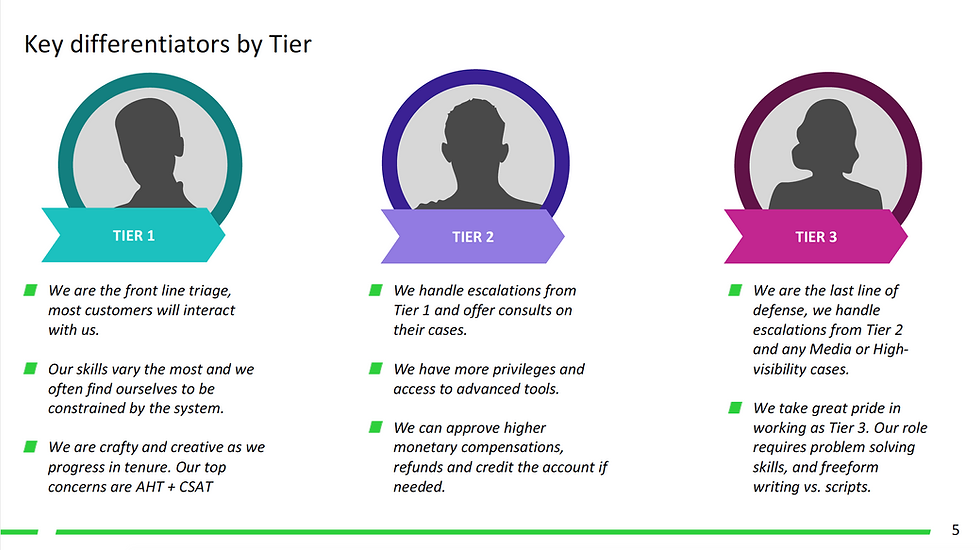
• Observed and interviewed call center agents to understand their workflow and escalation process for the different agent types: Tier 1, Tier 2, and Tier 3 (Complex Air Agents).
• Consulted with subject matter expert from the service delivery team and the line of business product managers on knowledge collected from past survey results and call center agent visits. The goal was to understand the issues that had the biggest impact on the business and the user experience pain points.
• Competitive analysis and heuristic evaluation of airline websites (United, Alaska, etc.).
• Task analysis and evaluation of the current user experience (Voyager Flights tool) that was being used to exchange, cancel, and void flights by Tier 1 agents in US/CANADA.
• Researched how the GDS is being used by Tier 2 agents and Complex Air agents.
User Scenarios
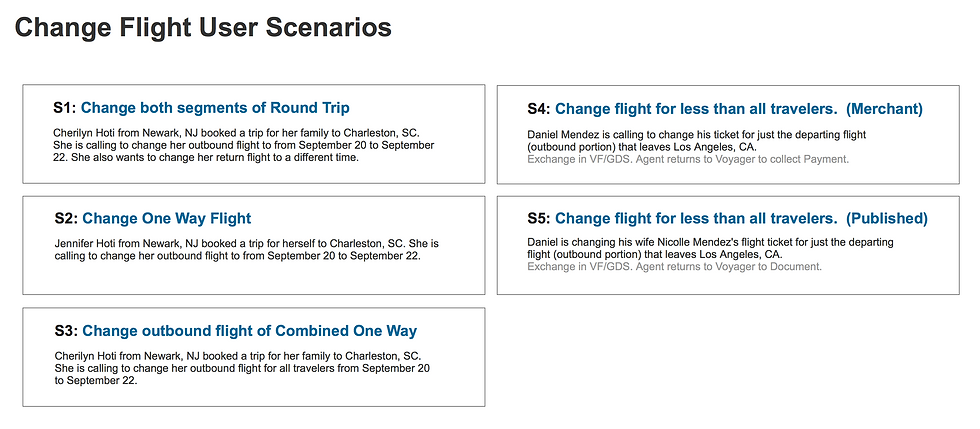
Identified key scenarios and use cases. Created wireframe screens in Sketch. Built out multiple prototypes in Axure for usability testing.
User Task Flow Diagram
I delivered scenario flows for the different use cases and handed off design for the following screen deliverables: Select Flights/Travelers, Search, Search Results, Review, Confirmation, and confirmation email template. I contributed to the style guide by introducing a new layout pattern on the Review screen for displaying the amount due for a flight exchange.
For the customer self-service portion, I delivered on the review, checkout, and confirmation user experience and ensured the end to end self-service flow worked for responsive web.

Design Deliverables
Created an html index page for the designs. Planned for a design schedule that took into consideration the multiple design iterations with usability testing as well as feedback from reviews with business owners.


Drafted a schedule and worked with dev team on alignment of the design deliverable dates would work with the dev milestones.
Drafted a schedule and worked with dev team on alignment of the design deliverable dates would work with the dev milestones.
Focus Group Session
Agents prioritized most common used tasks they use in Voyager Flights.


Background
Expedia Group branded customer care support agents (located throughout Philippines, San Salvador, Egypt, North America) face the challenge of having to use different tools and applications (GDS, Classic Voyager, Voyager Flights, Eureka, Brand Site for Agents, etc.) to exchange customer flight bookings. On the Voyager Flights tool, agents have to manually determine penalty, change fee policy, and booking class rules which if done inaccurately lead to airline debit memos that adversely impact the business.
Incomprehensible system errors due to issues in downstream services and the inability to display information due to out of sync booking information when backend systems pull from different data stores also add to the pain points agents experience. When the agents don't know what their next step should be to resolve their customer's problems it leads to dissatisfaction. Tier 2 and Tier 3 agents have to memorize 15+ key commands for the different GDS systems they use to service flight bookings. There existed an opportunity to make a more user friendly interface that could quickly give the agents the information they need and reduce their average handling time.
Design Process

Resume
Customer-focused designer, Created user interfaces, mobile and web applications, and visual, interaction design experiences for both enterprise and consumer spaces for: Microsoft, Amazon, AT&T, Expedia Group, Smartsheet and Blue Origin. Experience designing across devices and platforms. Creating connected experiences, social sharing, collaboration, productivity, communications, online shopping, user identity, and account management.
Experience
Customer-focused user experience and design strategy. Visual design and micro-interactions for design systems.
Over 25+ years of design industry experience. Delivered solutions that improved work productivity, collaboration,
communications, e-commerce, social sharing, identity, and account management.
linkedin.com/in/wilhelmina-wilo-dietrich-69b9971
Blue Origin | OCT 2022 – PRESENT
Senior User Experience Designer IV
At Blue Origin - Enterprise Technologies: Test & Flight Operations, my UX Design work focuses on test and flight data management and analysis experiences, AI-LLM-assisted troubleshooting, telemetry dashboards, and procedure operations. I've embedded LLMs into workflows, turned complex data into actionable interfaces, and led UX discovery work that secured new project funding. One project was recognized with a Company Liftoff Award, and another was featured by Blue Origin's Orbital Reef Chief Scientist at the 2024 ISSRDC conference presentation. For design systems, I created a visual style for persona representation used across persona cards and journey maps, which became part of the shared template library for the Enterprise Technologies Design Team. I also serve as a Bar Raiser at Blue Origin, evaluating talent across UX, engineering, and business administration roles.
Smartsheet | SEP 2020 – AUG 2022
Product UX Design Manager
At Smartsheet, I led the design team for Enterprise Admin, Data Flows, Connectors, and Data Governance, shaping how enterprise users manage and move information. I was also doing hands-on design, directly contributing to project deliverables for Data Shuttle, Connectors, and Data Governance. I facilitated brainstorming sessions to frame product design thinking, partnered with product, program, engineering, research, design, and content teams on deliverables, vision, and roadmap, and rolled out accessibility specifications and guidelines to product areas. I scaled design teams in Edinburgh and Washington, promoted two senior designers to management roles and one designer to senior designer, expanded the Marketing Experiences and Data Flows teams, and was involved in hiring loops for design directors, product managers, content writers, and designers, while continuously developing my designers’ skills to drive growth, autonomy, and design excellence.
EXPEDIA, INC. | NOV 2016 – SEP 2020
Senior UX Designer III
At Expedia Group, on the Global Customer Operations Team, I led design initiative: Travel Connect. I contributed designs on the Virtual Agent Chatbot Conversation Platform for flight exchanges and cancellations, and payments agent chatbot widget. Delivered scalable virtual agent chatbot interactions, user interfaces, and experience flows that improved self-service, accessibility, and operational efficiency. The Travel Connect project resulted in the creation of two separate organizations, and the team earned the company's yearly impact award and the quarterly configurable award. I partnered with cross-functional teams on vision, roadmap, and project execution, conducted international user research sessions and facilitated focus group testing in US, London, Lisbon, Manila, El Salvador, and integrated localization and regional considerations into designs. In the last two years, I hired and mentored interns working on Customer Loyalty experiences and Virtual Agent Developer Documentation (I acted in a design project management capacity to continuously develop team skills in accessibility and drive growth and design excellence). For the conversation platform, I brought in a UX researcher for the team.
AT&T MOBILITY | FEB 2013 – AUG 2016
Senior Visual & Interaction Designer / Senior Product Marketing Manager
As a designer on the AT&T Mobility App & Devices Team – Entertainment Group, I worked with the team to design and deliver mobile and tablet experiences for AT&T services, including DriveMode, AllAccess, and Data Setup & Transfer, creating intuitive, user-centered interactions across Android, iOS, and Windows. Collaborated with product strategy and business development to create concepts visualizing future innovation, leveraging user research, market insights, and competitive analysis to shape next-generation experiences in 5G connectivity, device onboarding and troubleshooting, AI-driven location and context-based recommendations, and connected device usage monitoring. Partnered with cross-functional teams (researchers and branding) to translate insights into prototypes, flows, and high-fidelity designs. The DriveMode app was recognized in USA Today for its innovative mobile solutions. Passionate about human-centered design, UX best practices, and emerging digital trends.
MICROSOFT CORPORATION | APR 2005 – FEB 2013 Product Designer II
As a designer, I contributed to Microsoft Office Lync, Windows 8 Calendar, Windows Live Mail & Writer, MSN Hotmail, Family Safety, and Microsoft Billing, delivering scalable, user-centered experiences for millions of users. For Microsoft Office Suite 2013 release, on Microsoft Lync 2013 (now Microsoft Teams), I provided art direction and managed the design system and style guide. I developed an automated batch script icon process that reduced time and costs. I managed a team of 2 designers and 1 program manager, oversaw vendor budgets, and art directed 4 remote designers. In all 3,400+ icons including accessibility versions created, produced, and released. Designed Presence Status visual indicators to meet accessibility inclusive design usage across Microsoft Office Suite 2013 (Iconography was used across Office Product Lines: Word, Excel, PowerPoint, OneNote, and Lync). Designed the Photo-Mail Album Template visuals, a shareable photo-sharing, email attachment, and cloud storage component used across Windows Live Writer, Windows Live Mail, and MSN Hotmail. Additionally during my tenure at Microsoft, I designed account monitoring, social sharing, and productivity experiences for Windows Live Writer, Windows Live Profile, and Family Safety, enabling users to connect, share, and manage their digital lives.
AMAZON.COM | SEP 1999 – JAN 2005
Senior Designer // Senior Design Manager
Led design and launch of new product store tabs on Amazon.com, including Computers, Cell Phones & Service, and Software, driving growth in the consumer electronics category. Oversaw the Technical Products Group (TPG) design team and managed end-to-end delivery of user-centered shopping experiences. Defined user goals, synthesized business requirements, and applied design principles to create effective, scalable experiences across home pages (store tabs), category pages, product detail pages, search, results, shopping cart, order pipeline, partner-branded storefronts, warranties, rebates, bundles, and seller trust initiatives. Contributed to innovation and future product concepts as part of side projects exploring new retail opportunities. Partnered with the Business Development and Strategy Team to create online branded store proposals that secured partnerships with Samsung, Nokia, AT&T, Sprint, and Voicestream, each resulting in custom-branded stores on the Amazon platform. Drove cross-site visual and interaction design standards for Amazon’s International Order Pipeline Migration, managing global collaboration with designers in Japan, the U.K., Germany, France, Canada, and the U.S. to launch unified checkout design patterns across all regions. Created and launched designs for Amazon Seller Central, enabling small to medium businesses to list products, monitor sales, manage fulfillment, shipping, gift wrap, fraud protection, and customer satisfaction, helping merchants grow and scale through the Amazon ecosystem.
Education
MBA CANDIDATE, JOHNS HOPKINS UNIVERSITY, Projected Graduation: May 2026
BFA GRAPHIC DESIGN, UNIVERSITY OF WASHINGTON, Graphic Design, 1994
